Cheng-Qi Zhang

Move the light, then select a section.Tap a section to aim the lamp.

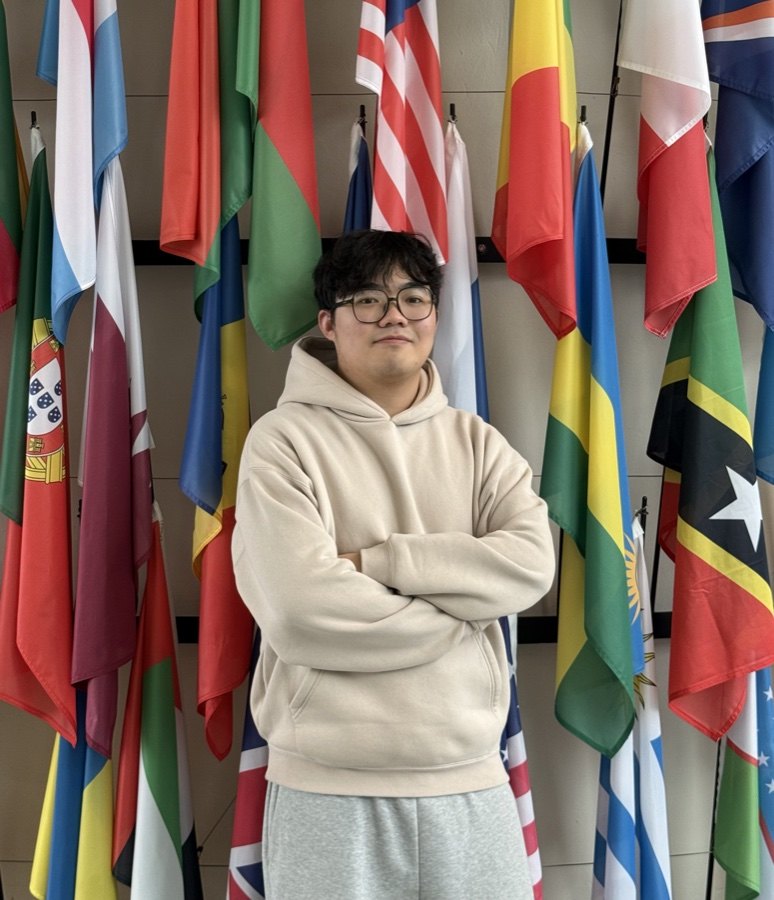
Cheng-Qi Zhang standing in front of international flags

About me

M.Sc. student in physics at Beijing Normal University

Based in
Beijing, China
Gender
Male
Birthday
MBTI
ENFP / ENFJ

Personal statement

I studied radiation protection and nuclear safety as an undergraduate in Chengdu. I’m now doing a master’s in physics at Beijing Normal University, where I use particle-in-cell simulations to study how target shape and laser pulse timing affect proton acceleration.

At the IAEA in Vienna, I worked on fusion technology modules for FUSE CONNECT and helped put together a database of fusion devices. During my internship at ENN Group, a private fusion company in China, I’ve worked with soft X-ray data from its EXL-50U tokamak and used Monte Carlo simulations to compare neutron shielding for a gamma-ray diagnostic.

Education

  • Beijing Normal University M.Sc. in Physics 2024–2027 (expected)
  • Chengdu University of Technology B.Eng. in Radiation Protection and Nuclear Safety 2020–2024

Internship experience

ENN Group

Fusion Diagnostics Intern · Beijing

Oct 2026–Present

I reconstructed soft X-ray spectra from calibrated detector events on EXL-50U, corrected for detector efficiency and fitted the continuum to estimate electron temperature. I also checked event coverage across discharges and used 20 ms windows to flag gaps.

In a separate project, I used Monte Carlo transport to compare neutron shielding configurations for a gamma-ray diagnostic.

International Atomic Energy Agency

Fusion Intern · Vienna

Oct 2025–Oct 2026

I led content development for the fusion technology modules on IAEA FUSE CONNECT and helped compile a database of fusion devices, including machine parameters and fuel-cycle information.

I also helped prepare discussions on remote handling and fusion workforce development. That work gave me a closer look at what it takes to operate and maintain a fusion device.

Other experience

Beixin Health Technology

AI Research Intern · Beijing

Dec 2024–Jul 2025

I worked on the design of AI-guided wellness tools.

IKEA

HR Intern · Chengdu

Dec 2023–Sep 2024

I helped onboard new employees and supported staff training.

Apple

Specialist Intern · Chengdu

Aug 2020–Oct 2022

I provided customer support and helped customers transfer data between devices.

Academic research

Target design · 2D PIC

How target geometry shapes a proton beam

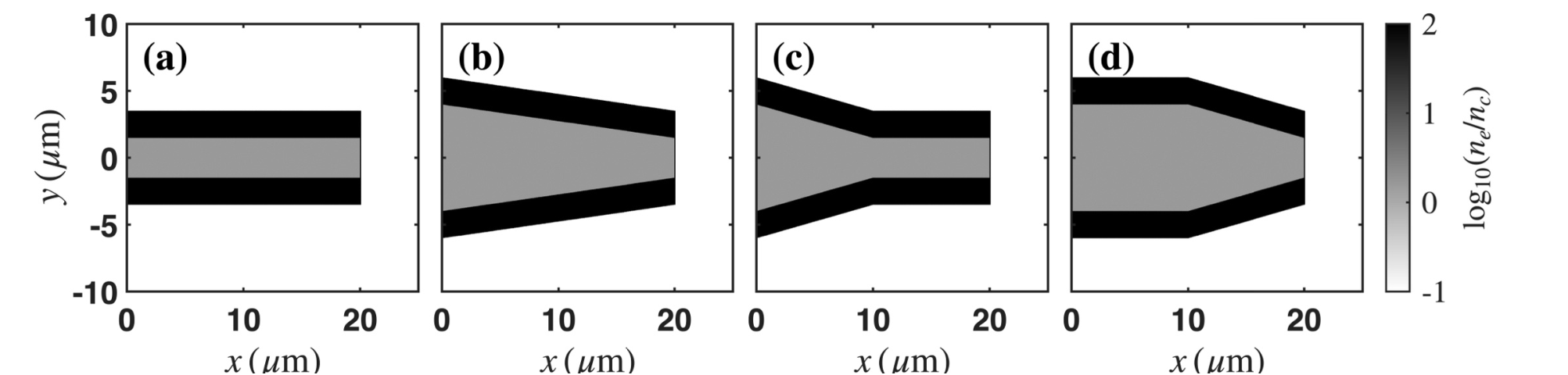
I compared straight cones, grooves and hybrid funnels filled with near-critical-density plasma. In our simulations, the straight cone produced the highest proton cutoff energy among the geometries tested. I analysed how laser self-focusing and hot-electron confinement helped sustain the accelerating field.

Read the paper ↗
Four panels showing the initial electron density in a rectangular groove, straight cone, and two hybrid funnel targets
Initial electron density across four target geometries. Zhang et al., Fig. 1. Figure source ↗

Pulse shaping · Bayesian optimization

Two pulses, one energy budget

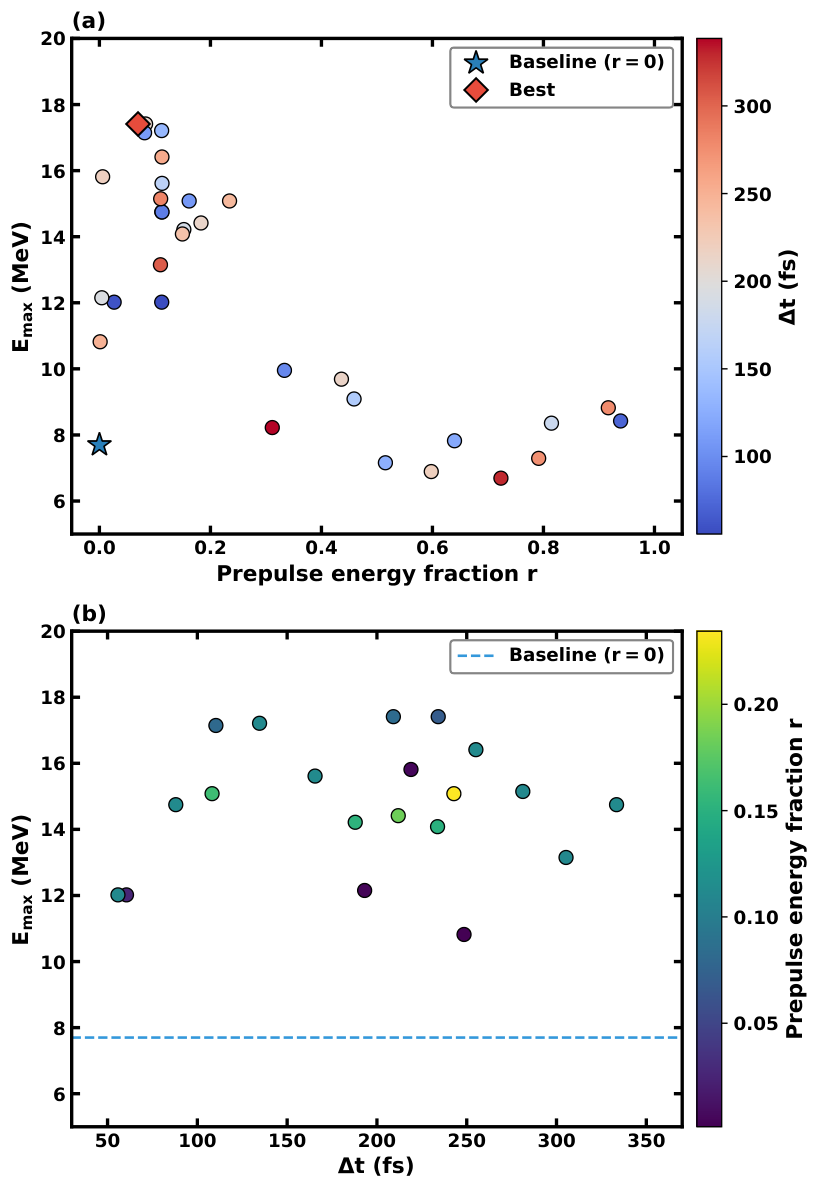
I used Bayesian optimization to tune the delay and the energy assigned to the leading pulse while holding total laser energy fixed. In the simulated comparison, the proton cutoff energy rose from 7.7 MeV for one pulse to 17.7 MeV for the optimized pair.

Read the accepted manuscript ↗
Two scatter plots showing proton cutoff energy versus prepulse fraction and pulse delay
Simulated cutoff energy for different pulse fractions and delays. Zhang et al., Fig. 4. Figure source ↗

Scientific machine learning · Preprint

Predicting proton spectra

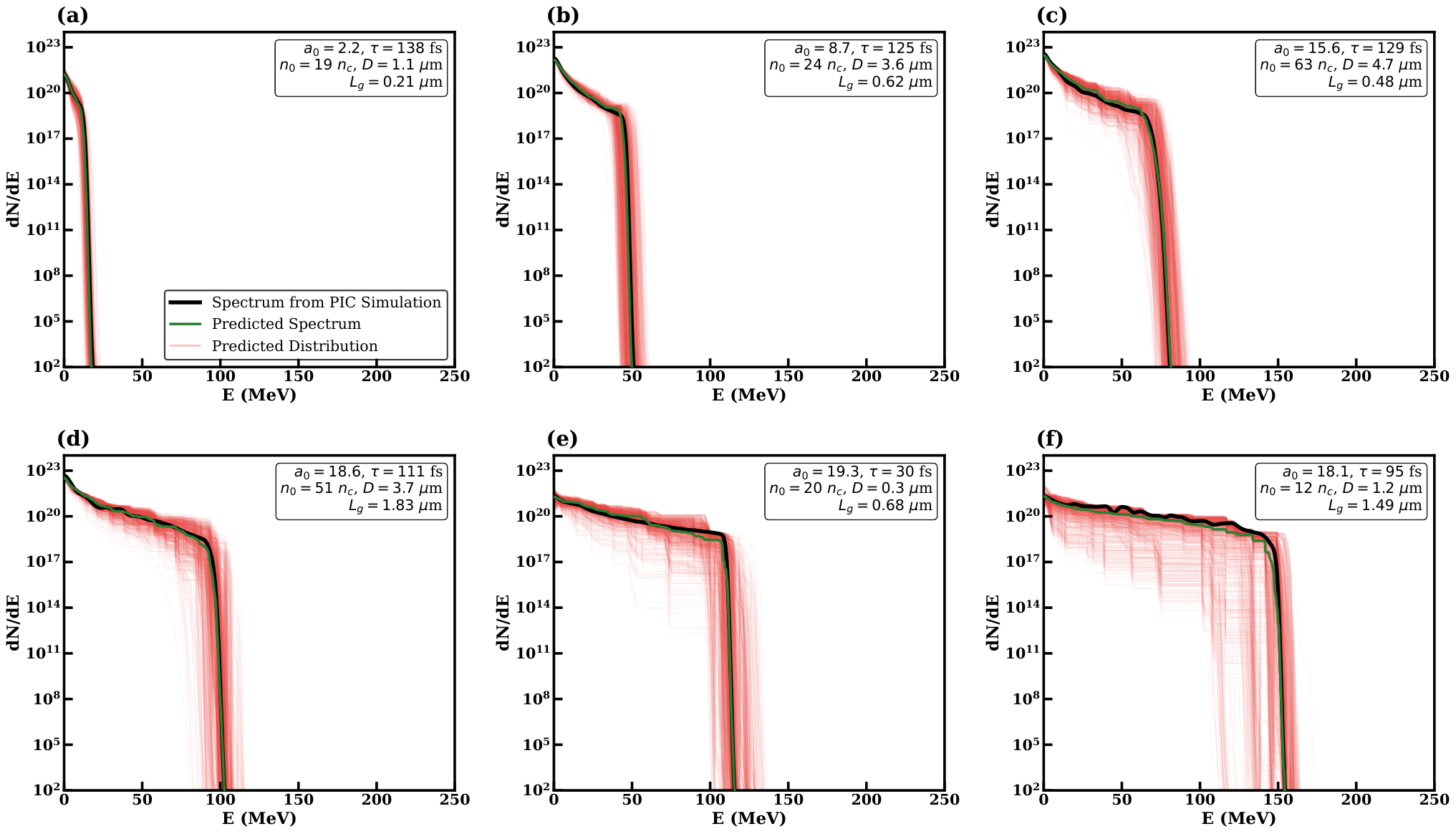
I worked on a surrogate model that predicts the full proton energy spectrum from laser and target parameters. We used a separate prediction for the cutoff energy to retain the sharp high-energy boundary when reconstructing the spectrum.

Read the preprint ↗
Panels comparing predicted proton energy spectra with particle-in-cell simulation results
Surrogate predictions compared with PIC spectra. Zhang et al., Fig. 2. Figure source ↗

Publications